

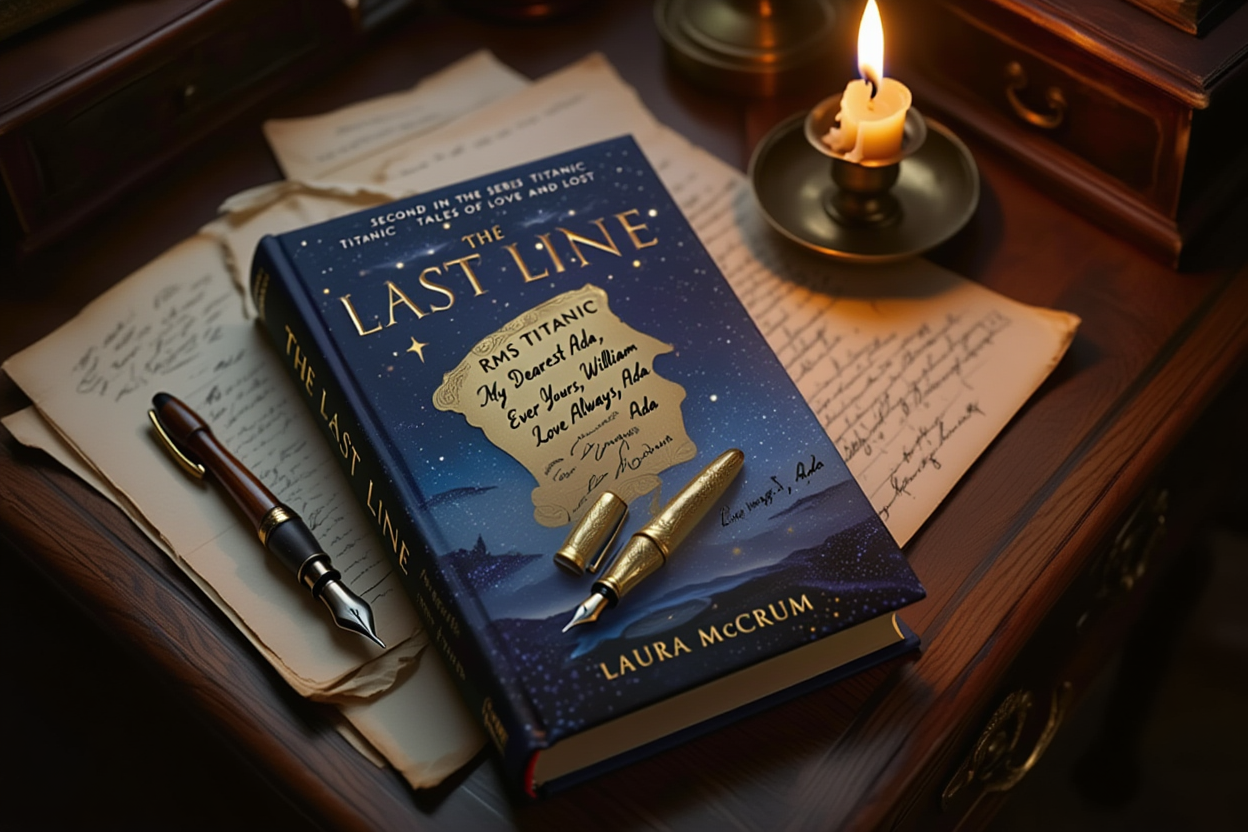
The Last Line - A Titanic Novel (Titanic Tales of Love and Loss - Book Two Of Three)
A Powerful tale of sacrifice, second chances, and the final days of Titanic's bravest officer.
He spent his life saving others.
But on the final night of Titanic... who was left to save him?
April 1912.
First Officer William Murdoch boards the RMS Titanic, carrying far more than the weight of responsibility. Newly separated from the woman he loves, he leaves behind his beloved wife Ada with promises of a future they are only just beginning to build. Yet from the moment the Titanic leaves Southampton, an uneasy shadow follows them both.
Through letters never meant to become a final goodbye, William and Ada cling to one another across the Atlantic. While Ada waits anxiously at home, haunted by growing fears she cannot explain, William walks the gleaming decks of the world’s most famous ship, witnessing the hidden tensions, class divisions, secrets, and quiet desperation unfolding beneath its luxurious surface.
As passengers chase dreams of love, wealth, freedom, and reinvention, William becomes entangled in the lives of those aboard. A frightened mother tormented by terrifying premonitions. A vulnerable young woman travelling alone. A stalker hiding among the passengers. Crew members pushed to exhaustion. And beneath it all, the unbearable pressure of command rested upon his shoulders.
Then comes the iceberg.
In the freezing darkness of April 15th, William Murdoch must make impossible choices as chaos engulfs the Titanic. While lifeboats descend into the black Atlantic, love stories are shattered, families torn apart, and ordinary people reveal extraordinary courage. But as the ship slips beneath the sea, one heartbreaking question remains:
How do you say goodbye to the love of your life when there is no time left?
Deeply emotional, richly atmospheric, and inspired by real historical events, The Last Line is a haunting Titanic love story about devotion, duty, sacrifice, and the unbearable cost of being the man everyone depends upon. Perfect for readers who love tragic romance, emotionally immersive historical fiction, and unforgettable stories that linger long after the final page.
Some love stories survive history.
Others are swallowed by the sea.
Perfect for readers who love:
⚓ Heart-wrenching historical romance.
💌 Real Titanic figures brought to life.
🌊 Parallel stories of love, loss, and resilience.
📜 Epistolary storytelling with letters and diary reflections.
Readers Love
In the early years of the 20th century, the officers of Britain’s great passenger liners occupied a unique place in society, respected, disciplined, and often quietly heroic. These were not men of great celebrity or fortune, but of skill, duty, and remarkable steadiness in an age enamoured with progress and speed. To serve as an officer on a transatlantic liner like the RMS Titanic was both an honour and a heavy responsibility, carried out with little public fanfare and great personal cost.
The career of a merchant officer typically began young. Many, like William McMaster Murdoch, went to sea as teenagers, apprentices on cargo ships or sailing barques earning their way through years of harsh conditions and exacting exams. Over time, they rose through the ranks: Second Mate, First Mate, and finally, Master Mariner. By the time they reached officer status on a great liner, they were men forged by discipline, storms, and the lonely vastness of the sea. Life aboard ship was structured and precise. Officers stood watch in four-hour shifts around the clock, responsible for everything from navigation to safety drills, passenger security, and lifeboat inspections. In the quiet hours at sea, they charted courses, studied the stars, and ensured that a floating city stayed orderly and on track. It was a role that demanded unwavering attention, calm judgement, and an ability to lead without flourish. But the glamour seen from the promenade decks did not always extend below. Officers were away from home for weeks, often months at a time. Though they wore crisp uniforms and ate in separate quarters, their lives were not always easy. The pay was respectable for the time, but not extravagant. The demands were high. Most, like Murdoch, were officers of the Royal Naval Reserve as well trained in both civil and military seamanship, ready to serve in wartime. Their loyalty was to the ship, the passengers, and the service they upheld. For married officers, the separation from home was perhaps the greatest burden. Letters were their lifeline, written at night in small cabins lit by a single lamp, folded carefully, and mailed upon docking. Wives like Ada Murdoch became accustomed to long silences and anxious waiting. The sea could give no promises. This story, though fictionalised, is rooted in the truth of one such life. William Murdoch was a real man, brilliant, capable, and devoted. He served with honour on the White Star Line, rising through the ranks with quiet dignity. He was at the bridge of the Titanic when she struck the iceberg. He was there when the lifeboats were lowered. And when the sea took her, he remained on board. The Last Line is a story of duty and devotion, of letters delivered posthumously, and of the man who wrote them. It is a tribute not only to William Murdoch, but to all those whose lives were spent in service, at sea, on land, in silence and in sacrifice, between the stars and the deep. Though their names are less frequently recorded in history, the wives of officers like William Murdoch lived lives marked by long absences, quiet strength, and constant uncertainty. Women like Ada Murdoch, educated, capable, and without children, were often expected to give up formal employment upon marriage. Though she had once worked as a teacher, Ada would have been considered a respectable, middle-class wife whose role was to manage the home, support her husband from afar, and carry the weight of waiting. In reality, many officers' wives found purpose in charitable work, church committees, or the quiet mentorship of younger women. These unseen acts of care and contribution were the fabric of Edwardian domestic life, deeply rooted in love, duty, and social expectation. This novel seeks to honour those women, too, the ones left behind to watch the sea, who carried on with courage and grace, though history often overlooked them. For those interested in learning more about the real William McMaster Murdoch, I recommend visiting www.encyclopedia-titanica.org, for a detailed and meticulously researched archive of passenger and crew biographies. The Dalbeattie Museum in Dumfries and Galloway, Scotland, also preserves his memory with care and pride. Both were invaluable in shaping the foundation of this novel, and I extend my sincere thanks to those who continue to honour his legacy.